学会旗舰会刊《CSIAM Transactions on Applied Mathematics》2025年第四期上线发行,欢迎查阅
2025年12月,中国工业与应用数学学会旗舰会刊《CSIAM Transactions on Applied Mathematics》(CSIAM-AM)上线发行2025年第四期。
CSIAM-AM于2020年4月正式创刊,是中国工业与应用数学学会与香港GLOBAL SCIENCE PRESS出版社合作出版的英文季刊。中国工业与应用数学学会前任理事长、武汉大学校长张平文院士担任主编,中国工业与应用数学学会理事长、浙江大学求是讲席教授包刚院士担任总编辑。
2024年CSIAM-AM再次被认定为“中国数学领域高质量科技期刊分级目录”应用数学类T1级,2025年影响因子(Impact Factor)为0.9。
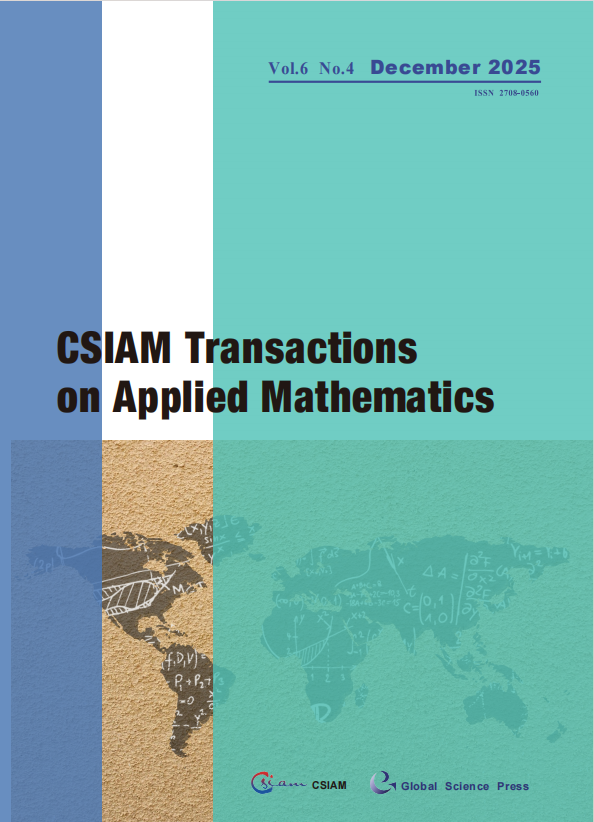
CSIAM-AM 2025年第四期共7篇文章,论文目录及作者信息如下:
Ran Zhang, Shangyou Zhang
Convergent Finite Elements on Arbitrary Meshes, the WG Method
Abstract: On meshes with the maximum angle condition violated, the standard conforming, nonconforming, and discontinuous Galerkin finite elements do not converge to the true solution when the mesh size goes to zero. It is shown that one type of weak Galerkin finite element method converges on triangular and tetrahedral meshes violating the maximum angle condition, i.e. on arbitrary meshes. Numerical tests confirm the theory.
Xiangcheng Zheng
Abstract: Variable-exponent fractional models attract increasing attentions in various applications, while rigorous mathematical and numerical analysis for typical models remains largely untreated. This work provides general tools to address these models. Specifically, we first develop a convolution method to study the well-posedness, regularity, an inverse problem and numerical approximation for the subdiffusion of variable exponent. For models such as the variable-exponent two-sided space-fractional boundary value problem (including the variable-exponent fractional Laplacian equation as a special case) and the distributed variable-exponent model, for which the convolution method does not apply, we develop a perturbation method to prove their well-posedness. The relations between the convolution method and the perturbation method are discussed, and we further apply the latter to prove the well-posedness of the variable-exponent Abel integral equation and discuss the constraint on the data under different initial values of variable exponent.
Lei Li, Yuliang Wang
A Sharp Uniform-in-Time Error Estimate for Stochastic Gradient Langevin Dynamics
Abstract: We establish a sharp uniform-in-time error estimate for the stochastic gradient Langevin dynamics (SGLD), which is a widely-used sampling algorithm. Under mild assumptions, we obtain a uniform-in-time bound for the Kullback-Leibler divergence between the SGLD iteration and the Langevin diffusion, where is the step size (or learning rate). Our analysis is also valid for varying step sizes. Consequently, we are able to derive an bound for the distance between the invariant measures of the SGLD iteration and the Langevin diffusion, in terms of Wasserstein or total variation distances. Our result can be viewed as a significant improvement compared with existing analysis for SGLD in related literature.
Dou Dai, Qiuqi Li, Huailing Song
An Efficient Iteration Based on Reduced Basis Method for Time-Dependent Problems with Random Inputs
Abstract: In this paper, we propose an efficient iterative method called RB-iteration, based on reduced basis (RB) techniques, for addressing time-dependent problems with random input parameters. This method reformulates the original model such that the left-hand side is parameter-independent, while the right-hand side remains parameter-dependent, facilitating the application of fixed-point iteration for solving the system. High-fidelity simulations for time-dependent problems often demand considerable computational resources, rendering them impractical for many applications. RB-iteration enhances computational efficiency by executing iterations in a reduced order space. This approach results in significant reductions in computational costs. We conduct a rigorous convergence analysis and present detailed numerical experiments for the RB-iteration method. Our results clearly demonstrate that RB-iteration achieves superior efficiency compared to the direct fixed-point iteration method and provides enhanced accuracy relative to the classical proper orthogonal decomposition (POD) greedy method.
Chao Liu, Bin Liu
Global Solvability in a Two-Species Keller-Segel-Navier-Stokes System with Sub-Logistic Source
Abstract: This paper is concerned with a two-species Keller-Segel-Navier-Stokes model with sub-logistic source in a bounded domain with smooth boundary under noflux/no-flux/no-flux/Dirichlet boundary conditions. For a large class of cell kinetics including sub-logistic degradation, it is shown that under an explicit condition involving the chemotactic strength and initial mass of cells, the two-dimensional Keller-Segel-Navier-Stokes problem possesses a global and bounded classical solution. In the case with arbitrary superlinear logistic degradation, it is proved that for all suitably regular initial data, the two-dimensional Keller-Segel-Navier-Stokes problem has at least one globally defined solution in an appropriate generalized sense. These results improves and extends the previously known ones.
Iván Area, Marc Jornet
A Mathematical Analysis for the Dynamics of Multiple Languages
Abstract: In many regions of the world, languages coexist in daily life, but often one tongue increases its use at the expense of another. In the present paper, we build a large compartmental system of differential equations that meets the situation of two “prestigious” tongues and many local languages, whose use is reduced by social interaction. The focus is on the preferred language in social relationships for communicating, rather than mere knowledge. We aim at stating and proving theorems on the qualitative behavior of the system. Numerical simulations illustrate the results, giving rise to distinct dynamics.
Tunan Kao, He Zhang, Lei Zhang, Jin Zhao
Abstract: We present partial evolutionary tensor neural networks (pETNNs), a novel approach for solving time-dependent partial differential equations with high accuracy and capable of handling high-dimensional problems. Our architecture incorporates tensor neural networks and evolutionary parametric approximation. A posteriori error bound is proposed to support the extrapolation capabilities. In numerical implementations, we adopt a partial update strategy to achieve a significant reduction in computational cost while maintaining precision and robustness. Notably, as a low-rank approximation method of complex dynamical systems, pETNNs enhance the accuracy of evolutionary deep neural networks and empower computational abilities to address high-dimensional problems. Numerical experiments demonstrate the superior performance of the pETNNs in solving complex time-dependent equations, including the incompressible Navier-Stokes equations, high-dimensional heat equations, high-dimensional transport equations, and dispersive equations of higher-order derivatives.
期刊官网:https://global-sci.org/index.php/csiam-am。
《CSIAM Transactions on Applied Mathematics》欢迎大家积极投稿,投稿网址: https://mc03.manuscriptcentral.com/csiam。
学会出版委员会供稿