祝贺!学会理事长包刚教授当选欧洲人文与自然科学院(Academia Europaea)外籍院士
Professor Gang Bao was elected as a Foreign Member of Academia Europaea
2026年4月1日,欧洲人文与自然科学院(Academia Europaea)在其官网公布了2026年度院士增选结果,共有来自全球的275位科学家当选。
中国科学院院士、中国工业与应用数学学会理事长、浙江大学求是讲席教授包刚当选为欧洲人文与自然科学院外籍院士(Foreign Member)。
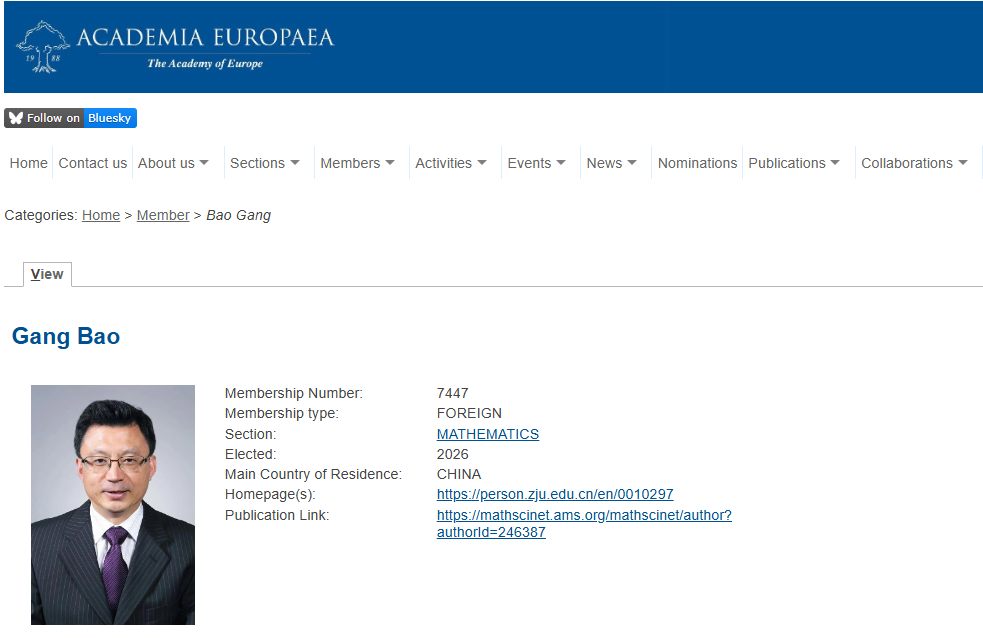
欧洲人文与自然科学院(Academia Europaea-The Academy of Europe),成立于1988年,总部设在英国伦敦,是由欧洲多国科学部长共同倡导创立、由英国皇家学会等多个代表欧洲国家最高学术水平的国家科学院共同发起成立的国际科学组织,涵盖人文科学、社会科学、自然科学和科学技术等众多学科领域,是国际上跨地域和学术领域最广泛、学术地位最高、影响力最大的国际科学组织之一。
欧洲人文与自然科学院院士主要从欧洲各国科学院院士中选出,代表欧洲人文和自然科学界最优秀的科学精英和学术权威。院士候选人选拔过程严格,首先由来自不同国家的院士推荐到科学部,经学部初审后推荐到提名委员会进行通讯评审,最后由欧洲人文与自然科学院的专门委员会审核通过。目前,欧洲人文与自然科学院有院士5800余人,其中不乏诺贝尔奖、图灵奖、菲尔兹奖得主,数学领域总计有243位入选者。
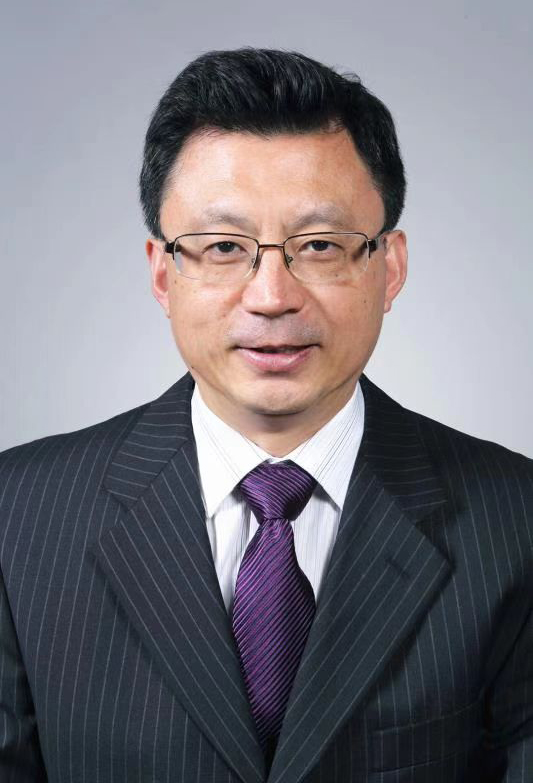
包刚,中国科学院院士、欧洲科学院(European Academy of Sciences)院士、发展中国家科学院(The World Academy of Sciences)院士,浙江大学求是讲席教授,浙江省特级专家。现任浙江大学理学部主任、浙江大学数学交叉研究中心主任、基础交叉研究院“数学+”交叉研究领域召集人。
包刚教授长期从事应用数学研究,特别是在数学物理反问题的理论、算法及应用于精准探测方面做出了系统创新性研究,是该领域数学理论和科学计算的国际领军人物。其主要学术贡献包括:发展了一般情形下波动方程反问题的稳定性理论,提出了求解麦克斯韦方程反散射问题的多频稳定算法,系统地建立了衍射光栅问题的数学理论,提出了求解偏微分方程及反问题的弱对抗网络深度学习算法。
包刚教授曾获冯康科学计算奖,密歇根州立大学杰出成就奖,国家自然科学奖二等奖(独立完成),国家教学成果奖一等奖,浙江省自然科学奖一等奖。入选美国工业与应用数学学会会士(SIAM Fellow),美国数学学会会士(AMS Fellow)。应邀在国际数学家大会作45分钟报告。曾任第九届国际应用反问题会议科学委员会主席,第十届国际工业与应用数学大会评奖委员会委员、Maxwell奖评奖委员会主席。现任第十一届国际工业与应用数学大会科学程序委员会委员、中国工业与应用数学学会理事长。
包刚教授诚挚感谢国际学术界给予的认可,他表示,这份认可既是鼓励,更是鞭策,接下来将继续潜心深耕学术研究,为中国数学乃至世界数学的发展注入新的动能。同时,也将积极行动,为进一步推动我国数学界与国际学术界之间的深度对话与合作贡献力量。
Professor Gang Bao was elected as a Foreign Member of Academia Europaea
On April 1st, 2026, Academia Europaea announced the results of its new members. A total of 275 scientists from around the world were elected.
Gang Bao, Academician of the Chinese Academy of Sciences, President of the China Society for Industrial and Applied Mathematics, and Qiushi Chair Professor at Zhejiang University, was elected as a Foreign Member of Academia Europaea.
Academia Europaea, founded in 1988 and headquartered in London, United Kingdom, is an international scientific organization jointly initiated by the science ministers of multiple European countries and founded collaboratively by the Royal Society and other national academies of science representing the highest academic level of European countries. It is one of the most prestigious and influential international scientific organizations, with the widest reach across regions and academic disciplines worldwide, covering humanities, social sciences, natural sciences and science and technology.
Members of Academia Europaea are primarily selected from the national academies of sciences across Europe and represent the most outstanding scientific elites and academic authorities in the European humanities and natural sciences. The selection process for candidates is rigorous. Candidates are first recommended by academicians from different countries to the Academic Sections. Following a preliminary examination by the Section, they are referred to the Nominations Committee for peer review, and ultimately approved by a Specialized Committee of Academia Europaea. Academia Europaea currently has over 5,800 members, among whom are numerous recipients of the Nobel Prize, Turing Award, and Fields Medal. A total of 243 members have been elected in the field of mathematics.
Gang Bao, Academician of the Chinese Academy of Sciences, Fellow of the European Academy of Sciences (EurASc), Fellow of the World Academy of Sciences (TWAS), Qiushi Chair Professor at Zhejiang University, and Distinguished Expert of Zhejiang Province. He currently serves as the Dean of the Faculty of Science at Zhejiang University, the Director of the Center for Mathematical Interdisciplinary Research at Zhejiang University, and the Convenor of the "Mathematics+" Interdisciplinary Research Area at the Institute of Fundamental and Transdisciplinary Research.
Professor Gang Bao has long been engaged in applied mathematics research. In particular, he has made systematic and innovative contributions to the theory and algorithms of inverse problems in mathematical physics, as well as their applications in precision detection, establishing himself as an international leader in the mathematical theory and scientific computing of this field. His major academic contributions include: developing the stability theory for inverse problems of wave equations in general settings; proposing multi-frequency stable algorithms for solving inverse scattering problems of Maxwell's equations; systematically establishing the mathematical theory of diffraction grating problems; and proposing weak adversarial network deep learning algorithms for solving partial differential equations and inverse problems.
He has received the Feng Kang Prize in Scientific Computing, the Michigan State University Distinguished Faculty Award, the Second Class Prize of the National Natural Science Award of China (as sole recipient), the First Class Prize of the National Teaching Achievement Award of China, and the First Prize of the Zhejiang Provincial Natural Science Award. He has been elected as a Fellow of the Society for Industrial and Applied Mathematics (SIAM Fellow) and a Fellow of the American Mathematical Society (AMS Fellow). He was invited to deliver a 45-minute invited talk at the International Congress of Mathematicians (ICM).
He served as the Chair of the Scientific Committee for the Ninth Applied Inverse Problems Conference, a member of the Prize Committee for the Tenth International Congress on Industrial and Applied Mathematics (ICIAM), as well as the Chair of the Maxwell Prize Committee. He currently serves as a member of the Scientific Program Committee for the Eleventh International Congress on Industrial and Applied Mathematics (ICIAM) and the President of the China Society for Industrial and Applied Mathematics.
Professor Gang Bao sincerely appreciates the recognition bestowed upon him by the international academic community. He stated that this recognition is not only an encouragement but also a motivation. Moving forward, he will continue to dedicate himself to in-depth academic research for the development of mathematics in China and around the world. At the same time, he will actively take action to further promote in-depth dialogue and collaboration between China's mathematics community and the international academic community.
学会办公室供稿,信息来自欧洲人文与自然科学院官网