学会新期刊《CSIAM Transactions on Life Sciences》2026年第二期正式上线发行,欢迎查阅
2026年6月,中国工业与应用数学学会新期刊《CSIAM Transactions on Life Sciences》(CSIAM-LS)正式上线发行2026年第二期。
CSIAM-LS是由中国工业与应用数学学会(CSIAM)继旗舰期刊《CSIAM Transactions on Applied Mathematics》后推出的一本新期刊,是学会CSIAM Transactions系列的第一个子刊。由中国工业与应用数学学会和香港GLOBAL SCIENCE PRESS出版社合作出版,为英文季刊,每年的3月、6月、9月、12月出版。
CSIAM-LS是一本创新性的跨学科期刊,聚焦数学与生命科学的交叉领域,覆盖生物学和医学的数学理论、模型和算法,包括计算系统生物学、生物信息学、生物医学工程、群体动力学、计算神经科学等。旨在推动传统数学生命科学的发展,开拓新兴方向,促进学科交叉与融合。
该期刊由中国科学院院士、武汉大学校长张平文担任主编,上海交通大学数学科学学院讲席教授楼元担任总编辑,拥有一支顶尖学者组成的编辑委员会,包含美国国家科学院院士、英国皇家学会会士等63位数学生命科学领域的国内外知名学者。
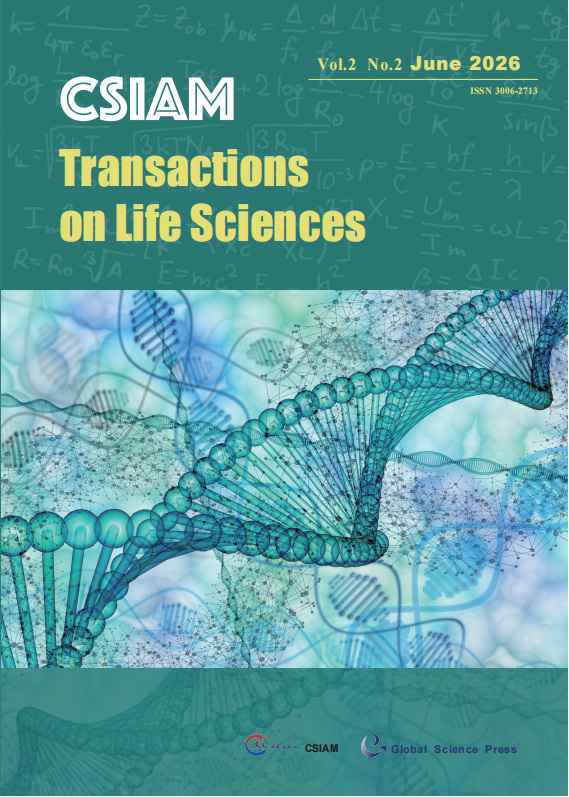
本刊2026年第二期共7篇文章,论文目录、摘要及作者信息如下:
Cong Li, Hui Zhang, Yi Tao, Xiu-Deng Zheng
摘要:Evolutionary stability (or evolutionarily stable strategy) is the core concept of evolutionary game theory. Although evolutionary game theory has achieved great success in evolutionary biology, economics and social science, etc. over the past forty years, how to understand the impact of environmental stochastic fluctuations on the evolutionary stability is still one of the most challenging issues in evolutionary game theory. This paper mainly introduces the recent advances in the study of stochastic evolutionary stability and stochastic Nash equilibrium within the framework of stochastic evolutionary game dynamics. These studies may provide a possible way to better understand the complexity of evolutionary game dynamics in real world situations.
Xiangzheng Cheng, Haili Huang, Ye Su, Qing Nie, Xiufen Zou, Suoqin Jin
摘要:In multicellular organisms, cells coordinate their activities through cell-cell communication (CCC), which is crucial for development, tissue homeostasis, and disease progression. Recent advances in single-cell and spatial omics technologies provide unprecedented opportunities to systematically infer and analyze CCC from these omics data, either by integrating prior knowledge of ligand-receptor interactions or through de novo approaches. A variety of computational methods have been developed, focusing on methodological innovations, accurate modeling of complex signaling mechanisms, and investigation of broader biological questions. These advances have greatly enhanced our ability to analyze CCC and generate biological hypotheses. Here, we introduce the biological mechanisms and modeling strategies of CCC, and provide a focused overview of more than 140 computational methods for inferring CCC from single-cell and spatial transcriptomic data, emphasizing the diversity in methodological frameworks and biological questions. Finally, we discuss the current challenges and future opportunities in this rapidly evolving field, and summarize available methods in an interactive online resource (https://cellchat.whu.edu.cn) to facilitate more efficient method comparison and selection.
Haonan Zhong, Jinliang Wang, Kaifa Wang
摘要:Based on the special blood supply system and microscopic structure of the liver, a series of novel Markov chain models is constructed to mimic the entire dynamic process of hepatitis B virus colonization, diffusion and evolution in liver, named as colonization Markov chain, diffusion Markov chain and evolution Markov chain. Theoretically, the colonization probability and infection distribution in hepatic lobules are first obtained. Then, the likelihood of sustained chronicity risk and the expected recovery time for chronic hepatitis B patients undergoing antiviral therapy are also derived. Numerical simulations validate the feasibility of models and the theoretical results. Especially, the model of evolutionary Markov chain with immune saturation may be suitable to simulate the clinically observed complex kinetic patterns of biomarkers, which has potential clinical application prospects.
Mengqi He, Dingding Yan, Sha He, Jianhong Wu, Sanyi Tang
摘要:Air pollution and disease transmission constitute a complex feedback cycle. However, the mechanistic relationship between the variation of air pollution (measured by air quality index (AQI)) and the disease transmission dynamics remains incompletely understood. Here we develop a framework to explore this relationship and we illustrate this framework by inferring the disease transmission rate and inflow rate of air pollutants (IRAP) from AQI and disease incidence data. The coupled system of disease transmission dynamics model and AQI dynamics model is integrated into physics-informed neural networks to embed the information retrieved from the coupled system to the loss function of the neural networks using automatic differentiation, the outcome of this data-driven network for transmission rate and IRAP is then converted into analytic forms of transmission rate and IRAP depending on incidence and AQI, using correlation analyses and symbolic regressions. Based on data from Shaanxi Province of China, this framework is used to establish a linear positive correlation between transmission rate and AQI, and between IRAP and disease incidence. We observe frequent fluctuations in transmission rate and IRAP and show that the mechanistic model with nonlinear analytic forms for transmission rate and IRAP learned through symbolic regression has robust predictive capabilities.
Bo-Han Si, Shi-Tong Yang, Meng-Guo Wang, Ke Jin, Li-Wei Wang, Xiao-Fei Zhang
摘要:Imaging-based spatial transcriptomics provides single-cell resolution but is restricted to targeted gene panels, leaving most transcriptional variation unexplored. Existing imputation approaches often rely on latent-space alignment, which can distort biological structure and capture limited within-type heterogeneity. We present BRIDGE, an interpretable framework that expands panel-limited spatial transcriptomics to transcriptome-level resolution through anchor-guided linear calibration and multi-scale neighborhood-based prediction. BRIDGE learns a global calibration matrix that directly adjusts shared-gene expression between technologies and provides explicit gene-level interpretability. Using the calibrated reference, BRIDGE predicts unmeasured genes by integrating multi-scale local neighborhoods to achieve both accuracy and robustness. Across seven datasets from CosMx, MERFISH, Xenium and multiple tissues and species, BRIDGE exceeds or matches existing methods on gene-level and cell-level accuracy. The calibration matrix offers clear biological interpretation, and the completed transcriptomes recover fine-scale spatial patterns such as cortical lamination and support refined characterization of cell-state heterogeneity, including B-cell states and Stromal subtypes in human breast cancer. BRIDGE provides a robust and interpretable solution for extending imaging-based spatial transcriptomics to transcriptome-scale analysis and enables deeper investigation of microenvironment-dependent cellular programs.
Ao Sun, Le-Le Fan, Ting Guo, Zhi-Peng Qiu
摘要:This study develops a time-varying model to investigate the impact of CD8+ T cell exhaustion on human immunodeficiency virus infection dynamics. For the corresponding autonomous model, the existence and local stability of equilibria are established. Bifurcation analysis reveals complex dynamics, including bistability involving multiple attractors and periodic solutions. Numerical simulations of the time-varying model demonstrate that the progression of CD8+ T cell exhaustion drives an increase in viral load and triggers a bifurcation-induced tipping (B-tipping) point. This leads to a rapid viral surge, which is characteristic of the transition from the asymptomatic stage to AIDS. The non-autonomous system robustly exhibits B-tipping regardless of the CD8+ T cell exhaustion rate (r), which primarily governs the speed of this transition. These findings highlight CD8+ T cell exhaustion as a key driver of post-infection disease progression and elucidate the mechanistic basis for rapid viral surges, thereby providing critical insights into human immunodeficiency virus pathogenesis and the development of therapeutic strategies.
Xiaoran Yu, Zhixiang Lin
摘要:Mass spectrometry-based single-cell proteomics (MS-SCP) enables the quantification of protein abundance in individual cells, offering a molecular perspective on post-transcriptional regulation and heterogeneity that cannot be inferred from transcriptomic data alone. However, MS-SCP data exhibit high rates of missing values, batch effects, and low-input noise, which require tailored computational models. In this review, we examine computational developments across the MS-SCP pipeline, covering protein identification and quantification, public repositories, data enhancement, and downstream analysis. We emphasize algorithms that integrate statistical modeling and deep learning for identification, quantification, and the joint correction of missingness and batch effects. We highlight the unique role of deep learning in modeling non-linear batch-dependent effects and learning robust protein representations from sparse, high-dimensional MS-SCP data. Finally, we outline future directions for method developers, including the incorporation of biological priors, the construction of abundance-level foundation models, the curation of single-cell perturbation datasets, and the integration of proteomic information with spatial and multimodal data.
期刊官网:https://global-sci.com/index.php/csiam-ls/index
《CSIAM Transactions on Life Sciences》欢迎大家积极投稿,投稿网址:https://ef.msp.org/submit_new.php?j=csiam_ls。
学会出版工作委员会供稿